
December: Get Ready for the Cold!
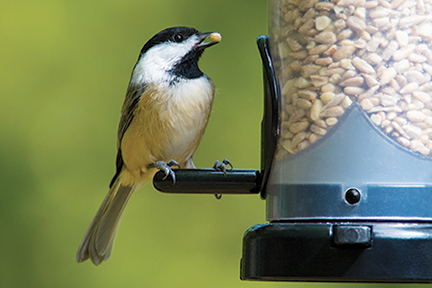
 We've already had a good amount of rain, and nights are getting into the 40s, so birds are feeling the colder temperatures. This is a good time, not only to keep your feeders full, but also to add some enrichment with more fat. A bag of Bark Butter Bits can be mixed into your regular feed or consider using our Winter SuperBlend with extra nuts, Bark Butter Bits and dried fruit.
Left: A Goldfinch, Titmouse and Sparrow enjoy a seed feeder
December is the month of bird counts. These citizen-science projects may seem like simple fun activities for kids or bird watchers. In fact, they are among the most important work of the year in bird science. These counts provide hard evidence about the status of our bird populations that scientists alone would be unable to produce. So, if you want to contribute to the welfare of our birds in a real tangible way, join one of these bird counts and make your observations count.
--Project FeederWatch, which began in November, continues through April. It doesn't matter if you start late. Every count is important. Visit FeederWatch to sign up.
--One day in the weeks around Christmas is the 126th Annual Audubon Christmas Bird Count, which will take place this year on Jan. 4, 2026. This celebrated count is in its 126th year, and still is considered one of the most important citizen-science projects for birds. The Audubon Society will offer a webinar on Dec. 1 for those who want to participate, though it will be available for viewing later.
Below: A Robin contemplates eating worms or berries from a feeder
 If you have toyon bushes, mistletoe or other fruiting trees, or even olives, you are likely to get visits by flocks of Robins. They come together into large groups as they forage in the winter for berries and fruits, one of their major food sources. Robins, which actually are in the thrush family, generally feed on the ground, probing for worms and grubs. They are famous for running on the ground, then stopping suddenly to listen for bugs below ground. Whole flocks happily visit birdbaths where they are available.
Millet is an important resource for the many ground feeders that show up in winter, especially the White-crowned Sparrows. Also watch for increasing numbers of Juncos and Towhees on the ground beneath those seed feeders. They need a blend with enough white millet to satisfy the large numbers of ground-feeding birds in the winter.
 One of the favorite events of winter is the arrival of flocks of Cedar Waxwings. Like Robins, these sleek beige birds with dark black masks arrive in flocks, sometimes commandeering an entire large tree, if it has plenty of berries. They sometimes pass each other berries or will launch themselves from the tree if a tasty insect happens by.
Left: Two Cedar Waxwings pass a berry along a branch
You probably will need binoculars to get a good look at them, but this month flocks of Surf Scoters and floating rafts of Western Grebes will form behind the surf zone. Surf Scoters are big strong ducks of salt water, mostly black except for patches of white on their backs and foreheads. The Western Grebes are long-necked with bright red eyes.
You have to bundle up to get out and see it, but the Geminid Meteor Shower is one of the best of the year. The meteors will be active through the 17th, and the full moon will have faded by the time it is at its height.